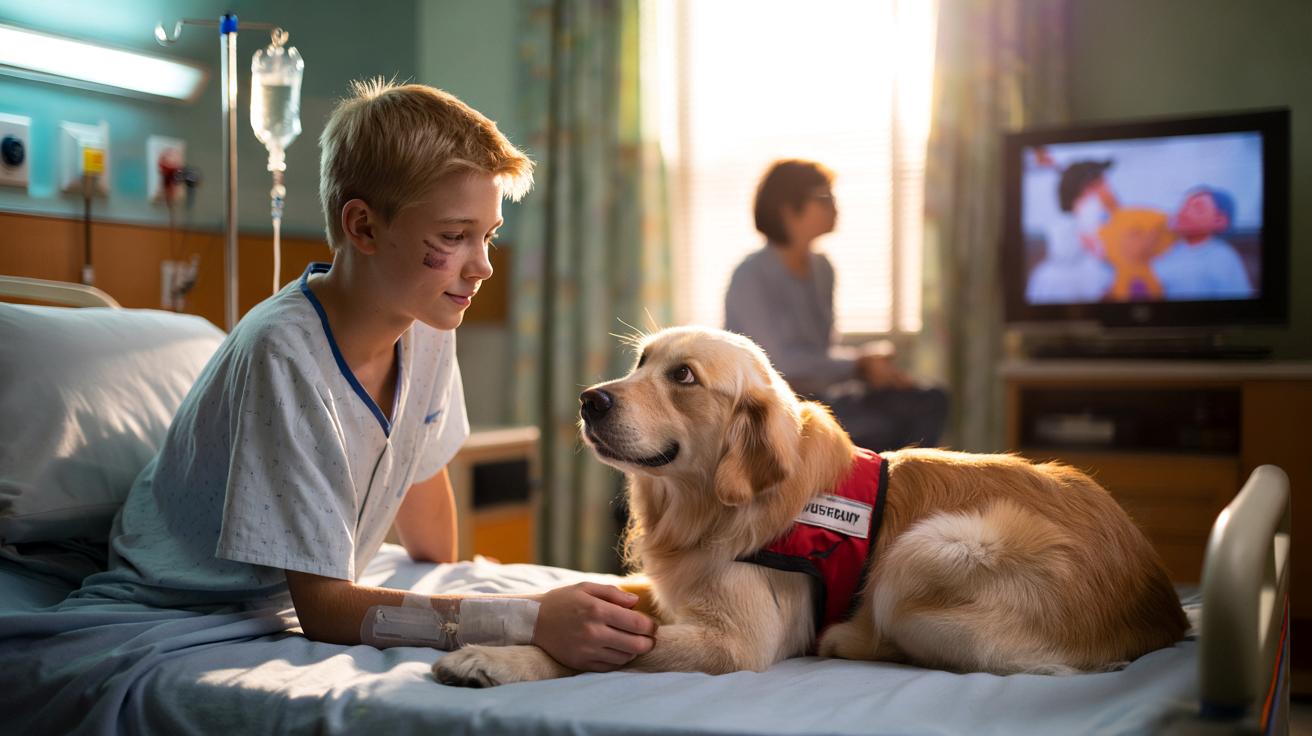
The first time they met, he looked more like a shadow than a teenager. Pale, eyes ringed with purple half-moons, fingers lost under tape and plastic tubes. She, on the other hand, trotted in with a tiny limp and a tail that refused to give up, nails clicking on the linoleum like she was late for something important. A golden retriever in a bright red vest, wearing her own IV line like an odd fashion accessory.
The nurse knocked lightly and swung the door open. “Ethan, this is Bailey. She’s a patient too,” she said, as if introducing two kids at a school playground, not two souls camped out on the edge of what might come next.
He lifted his hand slowly. Bailey pressed her head into his palm and closed her eyes.
The monitors didn’t change their rhythm. But the room did.
When a therapy dog walks into a hospital room
On the pediatric oncology floor, the air is thick with disinfectant and quiet courage. Doors are half-open, cartoons murmur from wall-mounted TVs, parents stare too long at their phones without really seeing them. Then once a week, like some small, stubborn sunrise, Bailey arrives. She’s not just any therapy dog: she’s recovering from surgery, fighting her own illness, her belly shaved and marked by a faint scar under her fur.
Kids spot her before they see the staff. Eyes light up, shoulders straighten, hands stretch out past IV poles. Nurses swear the hall grows a little wider when Bailey walks down it, like the building itself exhales.
Ethan wasn’t supposed to be excited about anything that day. The chemo had knocked him flat. Food tasted like metal, his body felt like it belonged to someone else, and the only thing that changed on his calendar was the color of the wristbands they gave him. Then Bailey padded in, sat down beside the bed, and placed her bandaged paw gently over the rail.
He stared at her shaved flank, at the patch where fur hadn’t grown back yet. “She’s sick too?” he whispered. The handler nodded. “She’s healing. One day, one nap at a time.” Ethan thought about that for a second. Then he shifted, wincing, and said, “Okay. We can do that.”
The nurse later checked his stats. His heart rate had calmed. His breathing was deeper. And for the first time that week, he didn’t ask what his blood test results were.
Scientists have tried to capture this in charts and numbers. They talk about lower cortisol levels, reduced pain perception, better adherence to treatment when therapy animals are involved. Hospital administrators nod through PowerPoints, calculating cost versus benefit. Still, none of those graphs really explain why a boy hooked up to three machines will suddenly sit up straighter when a dog with her own IV line walks in.
➡️ Boiling lemon peel, cinnamon and ginger : why people recommend it and what it’s really for
➡️ China planted so many trees in the Taklamakan Desert that it now absorbs CO2
There’s a quiet honesty in seeing another living being carrying scars that look a bit like yours. Not a superhero, not a flawless mascot, just a creature who’s clearly been through something and is still walking. *Healing suddenly stops being an abstract medical goal and becomes a shared project.* In that room, Ethan wasn’t just “the patient” anymore. He was Bailey’s teammate.
How shared vulnerability becomes medicine
The first thing Bailey’s handler does is slow the room down. She enters softly, lets the dog sniff the air, and reads the child’s face before anyone speaks. If the kid looks overwhelmed, Bailey lies down first, head on paws, eyes half-closed, saying with her body, I’m not in a rush. With Ethan, she was invited closer. The handler lifted Bailey’s vest slightly to show the line where her own surgery had been.
“See?” she said quietly. “She had a tumor too. She had to stay in a cage for days. She hated it.” Ethan’s mouth twisted in a familiar way. “Same,” he said. Then he slid his hand under Bailey’s collar, feeling the warmth of her neck, and something unclenched in him.
Most adults try to shield sick kids from the hardest truths. They say “we’re going to beat this” with a bravery that sometimes feels like a costume. A dog doesn’t wear costumes. A dog limps if she’s in pain, sleeps when she’s tired, shakes when she’s scared at the sound of a dropped tray. That unfiltered behavior gives kids a script they can follow without feeling weak.
During one session, Ethan watched Bailey hesitate at the doorway when a cleaning cart clattered by. She flinched, then stepped back, then inched forward again, ears low but tail gently wagging. Ethan laughed, the sound rough but real. “She’s scared but she’s doing it anyway,” he said. The handler just nodded. “That’s what brave looks like, right?”
He didn’t answer. He lay back on his pillow like someone who had just recognized themselves in the mirror.
Let’s be honest: nobody really does this every single day. By “this”, I mean facing illness with wisdom, patience, and perfect calm. Some days Ethan refused to see Bailey. Some days she was too tired to visit all the kids on the list. Those off days mattered too. They taught everyone in that hallway that healing isn’t a straight line, it’s a messy scribble.
An honest bond grew in the shared gaps, the missed visits, the postponed games of fetch in the hallway. When they did meet, there was no pressure to be inspiring. Ethan could just scratch behind Bailey’s ear while both of them pretended not to notice their matching medical bracelets. Their fight wasn’t a movie montage. It was small choices: sit up, drink this, take a step, let her on the bed.
Over time, that ordinary courage turned into something strong enough to lean on.
Turning a hospital room into a healing team’s locker room
One simple ritual shifted the energy of Ethan’s room: they started treating every visit like a tiny pre-game huddle. Before Bailey came in, the nurse would dim the lights just a bit, close the door halfway, and clear a space near the bed. No phones, no doctors popping their head in “just for a second.” For ten minutes, this was team territory.
Ethan would choose the activity: brushing Bailey’s fur, hiding treats under the blanket, teaching her a new command. That decision alone gave him a sliver of control in a life suddenly ruled by charts and schedules. When he finally taught her to rest her head gently on his chest on cue, his mother cried quietly in the corner. She wasn’t the only one who needed that moment.
If you’ve ever sat beside someone you love in a hospital, you know how easy it is to talk only about numbers. White blood cell counts. Temperature spikes. Next scans. A therapy dog interrupts that spiral. The conversation shifts to “She’s shedding everywhere” or “Did you see her snore?” and the body remembers what non-medical laughter feels like.
There are mistakes, of course. Some families feel guilty for smiling when things are serious. Some staff worry that animals will make kids forget the gravity of their condition. The truth is softer: joy doesn’t erase reality, it gives it edges you can grasp. When Bailey refused to play one day, flopping dramatically on the cool floor instead, Ethan’s parents panicked. The handler just shrugged. “She’s tired. Like you. Rest is part of the job.”
No one argued with that.
“Bailey didn’t cure my son,” Ethan’s mother told me later in the hallway, her eyes rimmed with that exhausted shine you only see in parents who’ve lived too long under fluorescent lights. “But she walked him through days we didn’t know how to survive. She made him feel like he wasn’t the only one doing something hard.”
- Create a simple ritualChoose a specific time or cue for visits (after blood draws, before bedtime). Regularity turns random comfort into a reliable anchor.
- Focus on one tiny goal per visitTeach a trick, tell a story about the dog, stroke the fur ten times. A clear, small target gives a sense of progress without pressure.
- Let vulnerability leadTalk openly about fear, fatigue, or boredom around the animal. Dogs absorb tension without judging, which makes it easier for humans to speak.
- Protect the bubbleAsk staff kindly to pause disruptions during visits when possible. That short window of emotional safety can feel bigger than the room itself.
- *Treat the animal as a teammate, not a prop*Notice their signals. If they’re tired or withdrawn, respect that. Shared limits deepen the feeling of being “in this together”.
When two patients walk out, none of them the same
Months passed in a blur of charts, long nights, and half-finished meals. Ethan’s hair thinned, grew back in fuzzy patches, and he started marking his height on the whiteboard every week again. Bailey’s fur slowly covered her scar, and her limp faded to a memory only the staff still noticed. On a quiet Tuesday, they posed for a photo: boy in an oversized hoodie, dog in a slightly faded red vest, both looking a little bewildered and quietly proud.
He was going home. She was being cleared for longer walks. They weren’t magically cured, both would always carry this chapter in their medical files and in their bones, but the worst of the storm seemed to be behind them.
Stories like theirs travel fast in hospital corridors. A nurse tells another nurse. A parent whispers it to a new family in the waiting room. Someone prints the photo and pins it on the staff bulletin board. Not as a miracle story, but as a reminder that healing isn’t only what happens inside machines and behind closed lab doors. It’s also what happens when a kid and a dog decide, quietly, to keep showing up for each other.
We’ve all been there, that moment when you realize you can’t muscle through something alone and you reach instinctively for a hand, a paw, a gaze that says “I see you.” Ethan and Bailey just happened to find that in a place most of us hope we never have to stay in for long.
Some readers will recognize themselves in Ethan’s stubborn jokes, or in Bailey’s sleepy determination to still wag her tail on bad days. Others might think of a grandparent, a friend, or even their own pet who somehow knew when to quietly rest their head on a knee at exactly the right time. These are not small gestures. These are survival skills.
Long after discharge papers yellow in a file and hospital wristbands are thrown in a drawer, what stays is the memory of who walked beside us. A teenager and a golden retriever, both wearing scars and hospital tags, shared a fight they never asked for. Side by side, step by shaky step, they turned a sterile room into a place where courage felt contagious.
Somewhere out there, other kids and other dogs are doing the same, right now, behind half-closed doors that suddenly feel a little less heavy.
| Key point | Detail | Value for the reader |
|---|---|---|
| Shared vulnerability heals | A sick teenager and an ill therapy dog connect through their visible scars and treatments | Shows that you don’t need to be “strong” or “fixed” to help someone else feel less alone |
| Small rituals create safety | Short, predictable visits turn chaotic hospital days into manageable segments | Offers a simple model for creating emotional anchors during any health crisis |
| Emotional support is real medicine | Lower stress, better cooperation with care, and more hopeful behavior appear around therapy animals | Validates the instinct to seek comfort from animals and relationships, not just treatments |
FAQ:
- Question 1Are therapy dogs in hospitals actually sick themselves, like Bailey?
- Question 2What kinds of illnesses can benefit from visits with therapy animals?
- Question 3Is there scientific proof that therapy dogs help patients heal?
- Question 4Can families request a therapy dog visit for their child in any hospital?
- Question 5What if a patient is afraid of dogs or allergic to animals?