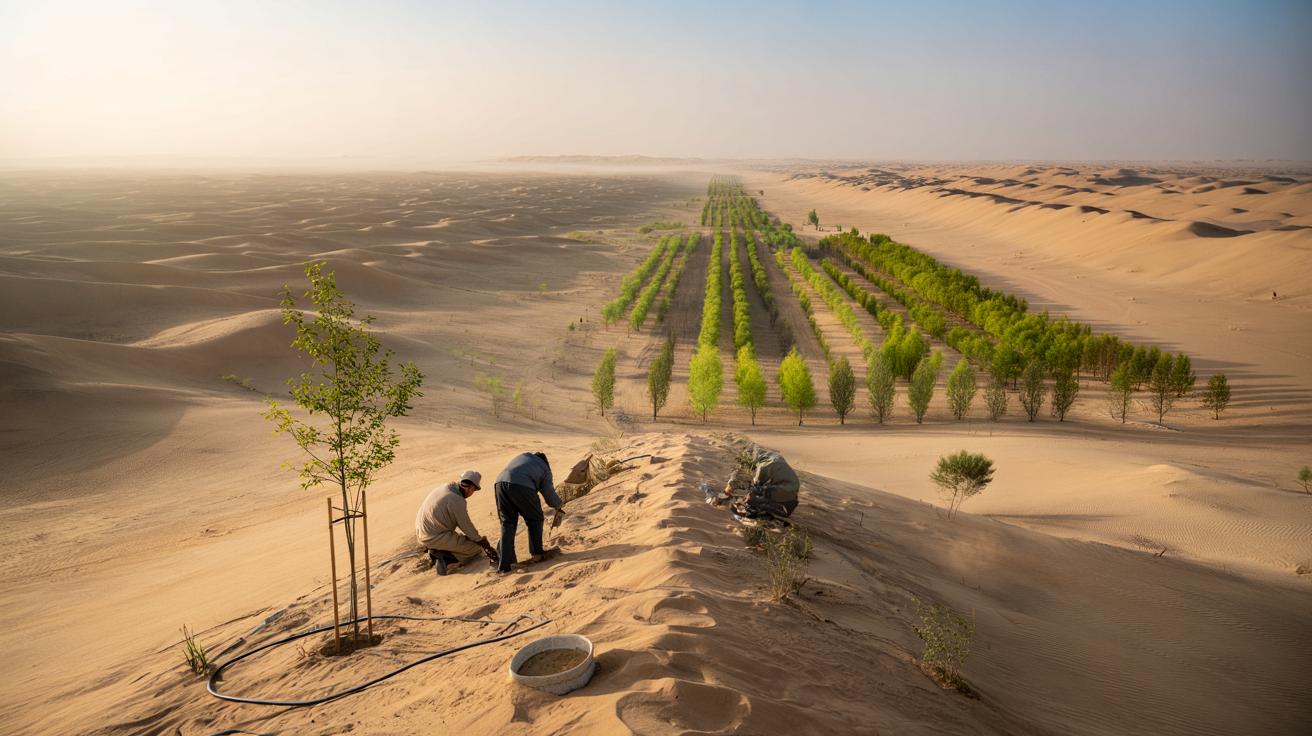
The air above the Taklamakan Desert used to shimmer like a mirage of heat and dust. From the window of a small propeller plane, the view was once nothing but endless sand, dunes curling like frozen waves. Today, pilots crossing this stretch of northwest China are starting to notice something that should not be there at all. Long, stubborn ribbons of green cut through the beige. Dark rows of poplars and shrubs trace the paths of ancient caravan routes, as if the Silk Road has grown leaves again.
Down on the ground, the change feels even stranger. You step out expecting the breath-stealing dryness of a dead landscape. Instead, you hear wind catching in branches, smell a faint resin scent, see patches of shade where there were none. Somewhere between ambitious policy and quiet daily labor, one of the world’s driest deserts started doing something new.
It began to absorb carbon dioxide.
The desert that wasn’t supposed to change
The Taklamakan is the desert people once called “the place you go in and never come out”. It’s vast, roughly the size of Germany, and for centuries it was a natural wall of sand between civilizations. No one expected it to become a climate experiment, let alone a carbon sponge.
Yet over the last three decades, China has tried to draw a green line across its dunes. From satellites, those belts of trees now look like scars of vegetation stitched into the sand. On the ground, they look more like defiance. A clear message that even a “dead” zone can be forced to breathe again.
The story really took shape in the late 1990s, when dust storms from the Taklamakan and neighboring deserts began to hit major Chinese cities more often. Fine sand would coat Beijing’s streets, turn skies a sickly yellow, and shut down airports in spring. People started taping windows, wearing masks long before the pandemic era, wiping off a new layer of dust every few hours.
Those storms weren’t just a local annoyance. They carried particles across the Pacific, reaching Korea, Japan, even the west coast of the United States. Chinese researchers and policymakers drew a direct line between expanding desertification in Xinjiang and growing urban chaos far away. That’s when the idea became clearer: instead of just fighting the sand, why not turn parts of the desert into a tool against global warming too?
Scientists began to notice something surprising. The new plantations on the edges and corridors of the Taklamakan weren’t just stabilizing dunes. Measurements showed they were starting to pull CO2 out of the atmosphere at a scale that mattered. Not like the Amazon, of course, but for a place that once stored almost no carbon at all, the shift was real.
The logic is simple enough. Trees and shrubs, even hardy desert species, absorb CO2 as they grow. Their roots trap carbon in the soil. Their leaves shade the ground, keeping moisture and organic matter from vanishing. Over time, those thin green belts act like elongated, living carbon filters wrapped around the desert’s throat.
The desert hasn’t turned into a lush forest. It probably never will. Yet against all odds, parts of the Taklamakan have quietly switched from being a bare reflector of sunlight to a modest, functioning carbon sink.
➡️ Boiling lemon peel, cinnamon and ginger : why people recommend it and what it’s really for
➡️ Both gravely ill, a therapy dog and a teenager meet in hospital and fight side by side to heal
How do you make a desert eat CO2?
On a cold April morning outside the city of Hotan, workers line up along a narrow trench carved into the sand. Each one holds a bundle of thin saplings, roots wrapped in damp cloth. There’s no dramatic machinery, no futuristic CO2 vacuum. Just shovels, plastic pipes, and people moving in a practiced rhythm. Plant, pack, water. Step forward. Repeat.
The method is surprisingly low-tech. Engineers first dig windbreak ditches and lay rows of straw or reed checkerboards to pin the surface. Then come salt-tolerant, drought-resistant species: mainly poplars, willows, and hardy shrubs like saxaul. Drip irrigation hoses snake underground, fed by carefully rationed groundwater or diverted river flows. The goal: help the trees survive the first brutal years. If they make it, their roots grip the dunes and start the slow work of fixing carbon from the air into living wood.
People who work on these shelterbelt projects talk about mistakes the way mountaineers talk about avalanches. You never really forget the first plantation that died. Rows of young trees baked under a sudden heatwave, or destroyed when a pump failed for just a week. An irrigation leak that went unnoticed and turned soil too salty, leaving a ghost forest of gray trunks.
Early projects tried to plant too densely, copying temperate forest models. The result was competition for water, shallow roots, high mortality. Over time, teams learned to space trees more widely, select tougher species, and accept that some areas will stay stubbornly bare. *The desert doesn’t negotiate, it just answers in silence.* That silence taught them to work with small, resilient patches instead of dreaming of a universal green blanket.
Researchers like to sum up the lesson in one plain sentence.
“You don’t green a desert with hope. You green it with data, patience, and low expectations,” a scientist from the Chinese Academy of Forestry once said at a field station near the Tarim River.
Behind those words is a quiet checklist that now guides most large-scale projects:
- Pick local or well-tested species that can handle salt, drought, and big temperature swings.
- Use drip irrigation and sensors to avoid both drying out and overwatering.
- Plant in belts and patches, not huge continuous monocultures.
- Combine trees with shrubs and grasses to build layered, rooted soil.
- Track not only survival rates, but actual carbon storage in biomass and ground.
Let’s be honest: nobody really does this every single day perfectly, especially across thousands of hectares. Yet this slow, slightly messy learning curve is exactly how the Taklamakan went from zero to measurable CO2 absorption.
What this desert experiment means for the rest of us
The Taklamakan is now a quiet test case for a question the whole planet is wrestling with. Can we use large-scale tree planting to genuinely help with climate change, or is it just another comforting story we tell ourselves? The answer sitting in those green belts is nuanced. They don’t cancel out China’s emissions, and never will. They don’t give anyone a free pass to keep burning fossil fuels.
Yet they do show something tangible: even harsh, degraded lands can be nudged into becoming small carbon sinks. Not miracle cures, but pieces of a much larger puzzle that includes cutting emissions, protecting existing forests, and changing the way we live. That matters more than the headlines about “the desert that eats CO2” suggest.
| Key point | Detail | Value for the reader |
|---|---|---|
| Deserts can change | China’s Taklamakan shelterbelts show that even extreme landscapes can store carbon if projects are persistent and well-designed. | Invites you to rethink what is “lost” land and where climate solutions might hide. |
| Method matters | Drip irrigation, local species, data monitoring, and realistic goals made the difference between dead plantations and living CO2 sinks. | Highlights that climate action is about craft and iteration, not magic fixes. |
| No silver bullet | Tree belts reduce dust storms and store carbon, but cannot offset large-scale emissions on their own. | Helps cut through greenwashing and focus on balanced, credible climate strategies. |
FAQ:
- Is the Taklamakan Desert really absorbing CO2 now?
Yes, field studies and remote sensing show that planted shelterbelts and river-oasis forests on the desert’s edges are acting as net carbon sinks, storing CO2 in both biomass and soil.- Did China “green” the whole desert?
No. Only specific corridors, edges, and oasis zones have been planted. The vast majority of the Taklamakan remains bare dunes, and that’s unlikely to change.- How does planting trees in a desert affect the climate?
Trees absorb CO2 as they grow, stabilize soil, and slightly change local microclimates. In arid zones, their cooling and carbon-storage effect is modest but still meaningful over large areas.- Is this good for local people?
In many cases, yes. Reduced dust storms, more stable farmland around oases, and some new jobs in forestry and maintenance have been reported. There are also tensions over water use and land rights in certain regions.- Can other countries copy this model?
Parts of it, yes. The core lessons—using local hardy species, careful water management, and realistic scales—can inform projects in places from Central Asia to the Sahel, as long as they’re adapted to local conditions.