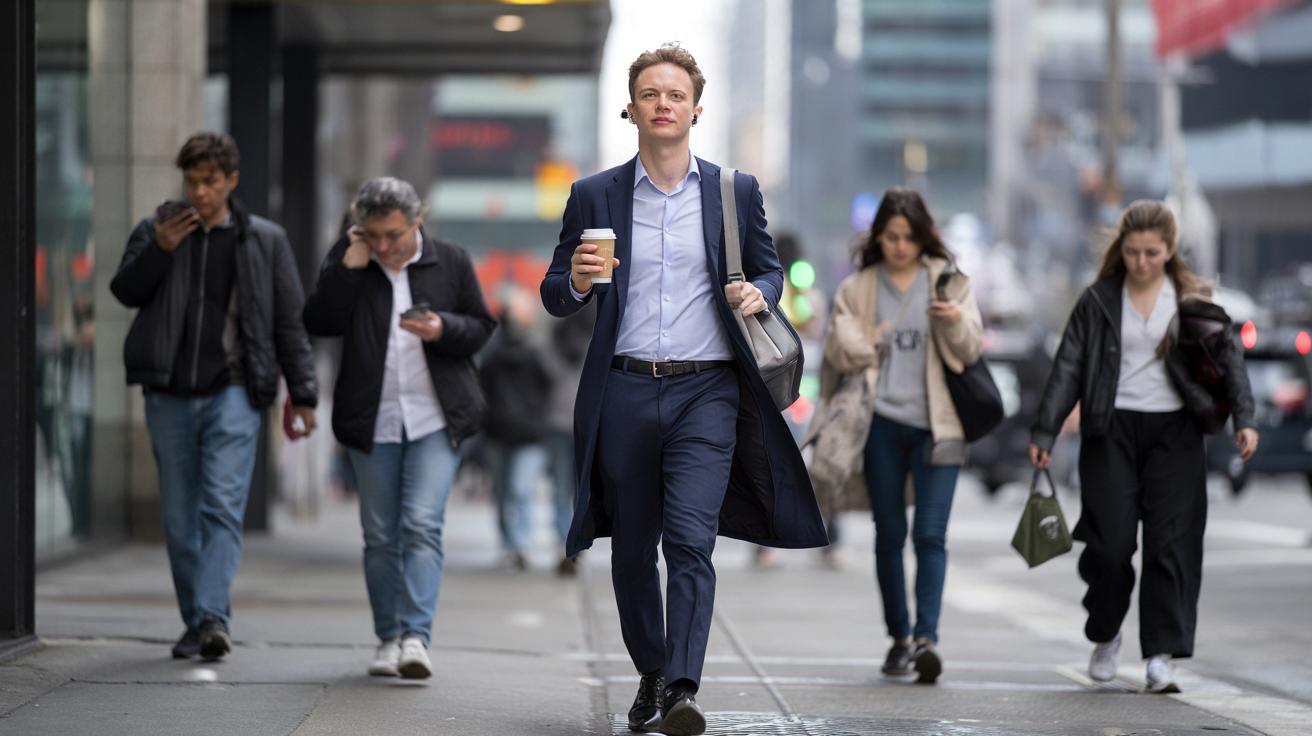
The scene plays out in almost every busy city street. One person slices through the crowd, headphones in, bag swinging, eyes locked on some invisible destination. Next to them, someone else drifts along, scrolling their phone, stopping at every window, walking as if time had taken a coffee break. Watching the two side by side, you can almost feel the difference in their inner world. One radiates urgency and focus. The other feels like life is something happening eventually.
Then you learn what behavioral scientists have been saying for years: this isn’t just about steps per minute. It’s a quiet clue about how your brain is wired, how you handle life, and sometimes, how far you’ll go.
The way you walk might be telling a story you’ve never read.
Why your walking speed says more about you than you think
Walk down any train platform at rush hour and you’ll start to notice a pattern. The people weaving quickly through the crowd often carry laptops, backpacks, or coffee cups held like tiny deadlines. Their bodies lean slightly forward, as if pulled by their next task. A few steps away, slower walkers amble, heads turned, bags loose, the world around them more of a background than a mission.
Scientists who study everyday behavior claim this isn’t random. For many of us, walking speed subtly reflects mental pace, decision-making style, and how we relate to time. A fast walk can signal a brain that likes to move quickly too.
In one large UK study involving nearly half a million people, researchers at the University of Leicester found that faster walkers tended to live longer and score better on cognitive tests. Another line of work from Duke University has linked walking speed in midlife with brain health measures usually associated with aging. That’s not about who’s fitter or who hits the gym the most. Even after accounting for weight and exercise habits, brisk walkers came out ahead in mental sharpness and long-term health predictions.
Imagine two colleagues leaving the same office. Same job title, similar salary. One strides purposefully to the subway, checks tomorrow’s calendar, already sorting priorities. The other wanders toward the coffee cart, half-checking messages, no real rush. Year after year, that small difference in pace might add up to more than steps.
Behavioral scientists often describe walking speed as a “micro-behavior” that reflects deeper traits. People who naturally walk faster tend to score higher on measures of conscientiousness and goal orientation. Their bodies are unconsciously syncing with an inner sense of urgency and direction. This doesn’t mean slow walkers are doomed or lazy, just that their default tempo may lean toward reflection, comfort, or distraction.
*The real story is that your walking speed can act like a quick snapshot of how you handle time, stress, and opportunity.* When life throws a choice at you, do you lean in and move, or do you drift and wait?
How to use walking speed as a quiet upgrade to your life
One simple experiment behavioral coaches love starts with something tiny: pick one familiar route and decide to walk it just a bit faster. Not sprinting. Just intentionally brisk. A 10-minute stroll becomes an 8-minute purposeful walk. You keep your eyes up, shoulders relaxed, phone away. You walk as if you’re slightly late to something that matters.
Do this on the way to work, during your lunch break, or between meetings. After a week, notice how your head feels when you arrive. That gentle uptick in pace often drags your focus along with it. Your body says, “We’re on a mission,” and your brain quietly agrees.
Most people try this once, then slide back into their old rhythm. Let’s be honest: nobody really does this every single day. Life gets messy, your bag is heavy, your mind is crowded, and the couch calls louder than your step counter. That’s fine. The mistake isn’t walking slow sometimes. The mistake is assuming your pace is fixed, that you’re either a “fast walker” or “not that type of person.”
A more forgiving approach is to link brisk walking to specific moments: when you’re about to start something hard, after a draining meeting, or before an important call. The small surge of movement works like a reset button, not a personality transplant.
Behavioral scientist Jason Berreby sums it up like this: “When you choose to walk with intent, you’re rehearsing how you want to move through the rest of your life. The pace is physical, but the message is psychological: I’m going somewhere on purpose.”
- Use walk speed as a cue: notice when you’re drifting and gently pick up the pace for the next 5 minutes.
- Pair brisk walks with thinking time: decide one key task or decision during each quick walk.
- Protect slow walks too: keep a few unhurried routes for recovery, creativity, or simply breathing.
- Avoid turning it into a moral test: speed is a tool, not a virtue signal.
What your future self might thank you for
There’s something oddly intimate about realizing your ordinary walk is a kind of public diary. You’ve probably never thought, “My career, my brain health, my resilience… all hiding in my footsteps.” And yet, the research keeps circling back to the same core idea: the tempo of your body often mirrors the tempo of your life. We’ve all been there, that moment when you’re trailing behind a group and suddenly feel a little out of sync, or striding ahead and wondering why you’re the only one in a hurry.
That feeling is data. Not a verdict, just a clue.
Some people will always be naturally slower, more observant, more absorbed in details. Others are wired to move fast, notice patterns on the fly, finish things early. Both styles have value. The quiet opportunity sits in noticing when your default pace is helping you and when it’s quietly holding you back. A chronically slow walk to work might be your body whispering, “I’m checked out.” A consistently rushed stride home might be your nervous system saying, “I never really stop.” Both messages are worth hearing.
The plain truth is that walking speed is one of the easiest behaviors to experiment with. You don’t need an app, a subscription, or a 5 a.m. routine. You only need a few ordinary journeys and a small decision: today, on this stretch, I’ll walk like my time matters. And tomorrow, on another stretch, I’ll walk like my peace matters just as much.
Between those two paces, something interesting starts to shift. Not just in your step count, but in who you feel you’re becoming when you move through the world with your own chosen rhythm.
➡️ Both gravely ill, a therapy dog and a teenager meet in hospital and fight side by side to heal
➡️ China planted so many trees in the Taklamakan Desert that it now absorbs CO2
➡️ Boiling lemon peel, cinnamon and ginger : why people recommend it and what it’s really for
| Key point | Detail | Value for the reader |
|---|---|---|
| Walking speed mirrors mindset | Faster walkers often show higher goal orientation and time awareness | Helps you read your own behavior and adjust your attitude in real time |
| Science links pace and brain health | Large studies find brisk walkers tend to live longer and score better on cognitive tests | Turns an everyday habit into a simple, long-term investment in clarity and longevity |
| You can train your tempo | Short, intentional brisk walks before or after key moments act as mental resets | Gives you a practical tool to feel **sharper**, more **focused**, and more aligned with your goals |
FAQ:
- Does walking faster really mean I’m more successful?Not automatically. Fast walking is a pattern often seen in driven, time-aware people, but success depends on many factors: opportunities, decisions, relationships, and luck. Treat walking speed as a clue, not a destiny.
- What counts as “fast” walking?Researchers usually talk about a brisk pace of around 4–5 km/h (about 2.5–3.1 mph) or more, where you feel slightly warm and your heart rate rises, yet you can still talk. The key is relative speed: faster than your usual comfortable stroll.
- Can speeding up my walk really improve my brain?Regular brisk walking is linked to better blood flow, mood, and cognitive function. It won’t turn you into a genius overnight, but it can support clearer thinking, better energy, and long-term brain health.
- What if I naturally walk slow and like it?That’s fine. Slow walking has benefits for creativity and stress relief. You don’t need to change your nature. Just experiment with slightly faster walks at specific times when you want more focus or drive.
- Is this just another way to glorify hustle culture?It doesn’t have to be. The real power lies in choosing your pace consciously. Some moments call for a strong, forward stride, others for a leisurely wander. Owning both speeds is the real edge.