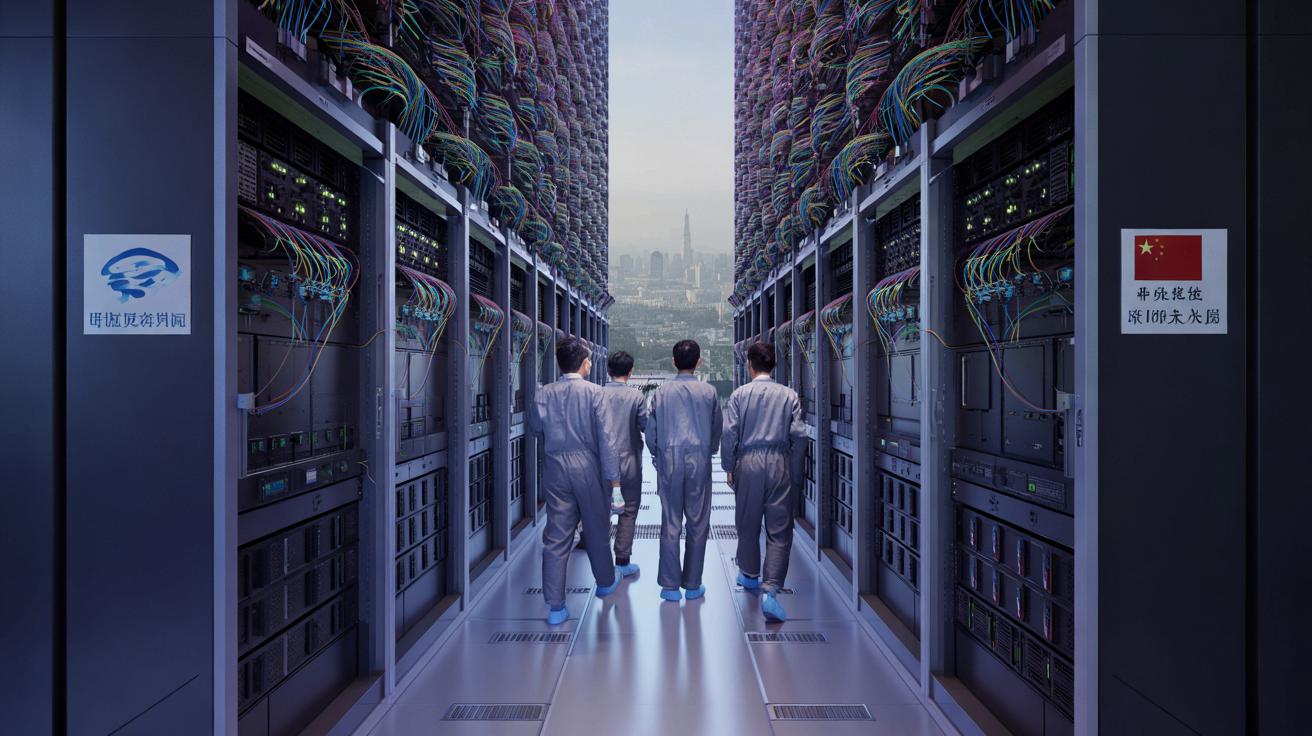
On a gray morning in Wuxi, a group of young engineers lines up in front of a windowless building that looks more like a warehouse than a revolution. They badge in, slip on anti-static shoes, and disappear into a humming, cooled-down universe of blinking LEDs and fiber cables. Outside, commuters scroll on their phones. Inside, these machines are quietly rewriting the balance of power.
You could miss the moment if you weren’t paying attention. No parade, no triumphant speech. Just a line in a research paper, a veiled announcement at a conference, a rumor about a new chip made “without any American parts.”
Yet something has clearly snapped.
The world’s most strategic computers no longer need permission from Washington.
China’s quiet exit from the American supercomputer shadow
For years, the world of supercomputers looked like a scoreboard where the United States and China took turns breaking records. A new #1 machine here, a faster benchmark there, always a hint of rivalry but also deep entanglement. American chips in Chinese machines, Chinese engineers trained in U.S. labs, global supply chains knitting it all together.
Then came the export bans. Washington started to squeeze access to cutting‑edge chips, especially anything that smelled like it could serve AI or military ambitions. That’s when the mood inside Chinese labs changed from anxious dependence to something more stubborn. *If we’re going to get blocked every two years, we might as well build everything ourselves.*
The turning point had a name: Tianhe-2, once the fastest supercomputer on the planet. Originally powered by Intel processors, it suddenly became a symbol of vulnerability when U.S. authorities refused to renew export licenses. Engineers in Guangzhou watched their upgrade roadmaps evaporate overnight.
So they pivoted. Chinese chipmakers accelerated work on domestic processors like Feiteng and Matrix-2000. In Wuxi, the Sunway TaihuLight system stunned the world by hitting over 90 petaflops using entirely homegrown processors. No Intel, no Nvidia, no American safety net. Just a loud signal that China could survive a technological cutoff and still climb.
That’s the kind of moment when a country stops asking for permission.
Behind the headlines and the geopolitics, the logic is brutally simple. Supercomputers aren’t just big calculators. They are the engines behind nuclear simulations, climate modeling, hypersonic weapons design, drug discovery, large language models, and real-time surveillance at massive scale. Whoever owns this power doesn’t just process data faster. They test weapons without firing, design planes without prototypes, and train AI on a scale most startups can barely imagine.
When Washington tried to slow that down, Beijing heard a different message: you’re strong enough to be feared. That’s why **China’s response wasn’t to complain – it was to double down**. Money, talent, and political capital were all redirected into one mantra: no more bottlenecks.
➡️ China planted so many trees in the Taklamakan Desert that it now absorbs CO2
➡️ Boiling lemon peel, cinnamon and ginger : why people recommend it and what it’s really for
➡️ Both gravely ill, a therapy dog and a teenager meet in hospital and fight side by side to heal
Inside the Chinese strategy to go fully “homegrown” in high‑performance computing
Pull back the curtain on China’s current supercomputing push and you don’t see magic, you see method. The first step was brutal: accept that foreign chips might be gone for good. That means rethinking everything from the processor to the cooling system. Step by step, researchers began stacking local solutions, even if they were a bit less shiny than Nvidia’s latest GPU.
The method is almost unglamorous. Incremental improvements to homegrown chips like Loongson, Phytium, and the mysterious Sunway processors. Domestic interconnects to replace foreign network hardware. Local accelerators tailored for AI math instead of gaming graphics. **Layer by layer, the U.S. component list shrank**. What remained was Chinese silicon, Chinese boards, Chinese know-how.
Of course, this shift wasn’t smooth. Chinese systems often had to deal with higher power consumption or less mature software ecosystems. Engineers long used to CUDA and U.S. programming tools suddenly had to adapt to new, domestic frameworks. Many quietly complained, off the record, that productivity dropped and bugs multiplied.
Yet the pressure was shared and openly acknowledged. There was no illusion of overnight miracles. The government poured billions of yuan into national supercomputing centers, pairing them with universities and AI labs. We’ve all been there, that moment when you’re forced to switch from a tool you love to one that simply… works differently. At scale, this frustration turned into a powerful alignment of incentives.
Public messaging also evolved. Instead of boasting loudly about every new record, China began to operate more discreetly, even skipping submissions to the TOP500 ranking for some of its newest machines. Analysts now suspect there are exascale‑class Chinese systems running quietly, unlisted, dedicated to AI and defense workloads.
One senior researcher from a coastal university, speaking under condition of anonymity, summarized it in blunt terms:
“Sanctions didn’t stop us. They just convinced the last skeptics that relying on American chips was a strategic joke.”
To follow this shift as an observer, three elements matter most:
- New domestic chips appearing in academic papers and patents.
- Government funding flowing into “national computing power networks.”
- Rising investment in AI training clusters that don’t use U.S. GPUs.
Let’s be honest: nobody really reads those policy PDFs cover to cover. But that’s where the future gets written.
What this new supercomputer independence means for the rest of us
China’s new supercomputing independence doesn’t stay inside secure data centers. It spills into daily life, often without us realizing it. Faster drug simulations could speed up generic medication design, cheaper weather models may improve flood warnings in Asia, and AI trained on massive Chinese language datasets is already changing how apps, services, and platforms behave.
These machines also redraw economic borders. Countries in Southeast Asia, the Middle East or Africa that feel uneasy about relying solely on U.S. cloud providers now see a second option: Chinese-built infrastructure, Chinese AI platforms, Chinese chips. For them, this is not just tech, it’s leverage.
There’s a more uncomfortable angle too. The same computing power that designs better wind turbines can also tune hypersonic missiles or power more refined surveillance systems. Human rights groups worry that advanced AI, fed by supercomputers, will supercharge real-time tracking and censorship capacities. At the same time, Western firms fear being outpaced in key AI benchmarks as the U.S. and China race for ever-larger models.
Many readers feel stuck between techno-optimism and quiet dread. You want medical breakthroughs and better climate forecasts, but you also sense that this arms race in computing won’t stay clean. *The line between innovation and domination is very thin when trillions of calculations per second are on the table.*
For people working in tech, policy, or even just paying attention, the plain-truth sentence is this: **the era when the United States could “choke” China’s high‑end computing with a single export rule is gone**. That doesn’t mean parity on every front, nor that Chinese chips match Nvidia overnight. It does mean that resilience has entered the game.
The coming years will be shaped by small, cumulative choices:
- Which cloud your company uses for AI training.
- Which country’s chips power your national research labs.
- Which standards your software teams quietly adopt as default.
These don’t make front-page news. Yet they lock in dependencies just as surely as any treaty.
| Key point | Detail | Value for the reader |
|---|---|---|
| China’s shift to domestic supercomputer chips | From U.S.-made CPUs and GPUs to homegrown processors like Sunway, Feiteng, and others | Helps you understand why U.S. export controls are losing some of their leverage |
| Supercomputing as a strategic weapon | Used for AI, defense simulations, climate models, and industrial design | Clarifies why this battle isn’t about “just faster computers” but long-term power |
| Emergence of a parallel tech ecosystem | Chinese chips, software stacks, and cloud services expanding beyond China | Signals future choices for countries, businesses, and developers worldwide |
FAQ:
- Is China already ahead of the U.S. in supercomputers?On paper, the two countries are close, and rankings don’t tell the full story because some Chinese machines are no longer listed publicly. The U.S. still leads in some areas, especially with Nvidia-powered AI clusters, while China seems to be focusing on quiet, domestically powered systems that may not show up on global lists.
- What changed after U.S. export controls on chips?Those controls cut China off from the most advanced U.S. semiconductors and design tools. Instead of collapsing progress, they pushed Chinese labs and companies to accelerate homegrown chip development and build full domestic supply chains for high-performance computing.
- Are Chinese supercomputers as good as American ones?They can reach similar raw performance on certain benchmarks, but efficiency, software ecosystems, and developer tools often lag behind leading U.S. platforms. That gap is narrowing fast as China invests heavily in compilers, frameworks, and AI-specific accelerators.
- How does this affect everyday people?You might feel it indirectly via faster AI tools, cheaper cloud services in regions close to China, or better climate and logistics models. On the flip side, it can also mean more sophisticated digital surveillance and sharper geopolitical competition over data and infrastructure.
- Should smaller countries pick a side in this supercomputing race?Many will try to balance both ecosystems—using U.S. tech where it’s strongest and Chinese options where costs or politics make them attractive. The real risk is locking into a single provider for critical infrastructure without a clear exit plan.